
This is a Man’s World belted out James Brown in 1966. And maybe it was. But today, for all of our inconsistencies and discrepancies, increasingly, mutual respect, equal opportunities and frankly, common sense, prevails. From the boardroom to the sports field, more and more, women are laying claim to their inborn privilege.
And yet, there’s one arena that’s almost exclusively overseen by males: religion.
Now, we’re not ones to query personal beliefs, but certain narratives inspire the question: what if? For the biggest world faiths of today, the respective deity is portrayed as male, meaning that for many, our spiritual sphere is – quite literally – a man’s world. So, what’s that all about?
The Hebrew God, the Torah tells us, is a He. Likewise for Christians, the single deity and said being’s only child are both male. Scriptures describe how Siddhartha Gautama – or Buddha as he’s more commonly known – was a male sage. Flick through the Quran for any number of suras describing God with masculine pronouns. Sure, semantics play a part – the transcribing and translating of ancient texts over thousands of years skews stories – and yet, divinities tend to be depicted as male. Huh.
Women on Top
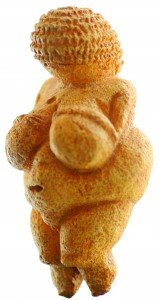
28 – 25th century BC
But it wasn’t always a man’s world. Archeologists the world over have unearthed ancient artifacts pointing to the widespread worship of goddesses― or one single Goddess―dating back some 25,000 years. Of course, that vastly predates writing, generally thought to have slowly started in Mesopotamia some five thousand years ago. Only through surviving icons and objects can historians speculate as to the beliefs and communities of one of the earliest societies whose curious trawl of trinkets and tools still survive the Paleolithic people.
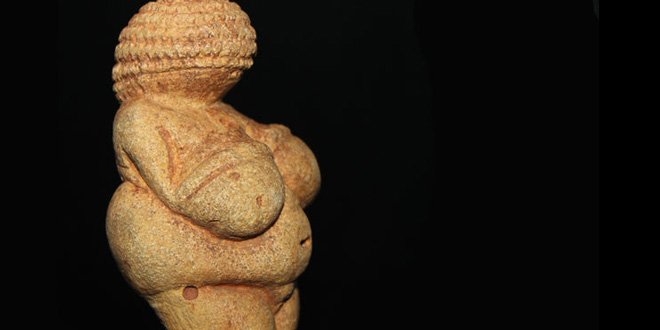
In particular, so-called Venus figures―small-scale models of exaggerated female forms cast in clay, stone, ivory or bone―may point to a prehistoric, woman-centric religion and by extension, society, with a Mother Goddess as its figurehead. Take the Woman of Willendorf, discovered in the eponymous Austrian village in 1908 and thought to have been made some time between 28,000 and 25,000 BC.
All full breasts, curved belly and ample bottom, she’s glorious, and tinted with red. It’s easy to imagine her contours and curves celebrating fertility and fecundity; perhaps that slick of color symbolizing the then-enigma of menstruation, mysteriously tied to the moon. And put like that, what’s not to exalt?
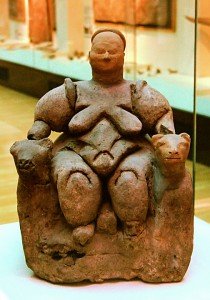
6000 BC
This adoration of female physiology continued. Case in point, the implausibly serene Seated Woman of Çatalhöyük: a nude figure of baked clay, depicted giving birth. This Great Mother Goddess, scholars posit, was all fruitfulness, life force and vitality – without any of that ‘good versus evil’ dualism that so dominates Western religions of today.
So what happened? If women were once so venerated, their rhythms and reproductiveness so hallowed, and if today’s religions were born from one single narrative, how did Christianity wind up with a virgin mother? And what of Jewish Niddah,deeming menstruating women ‘impure’?
Read The Divine Female: Part 2
Enjoy 15% off LELO.com with code VOLONTE15